



What is a Logical Framework?
Logical Framework, sometimes called Logframe, is used for project planning. It is a standard approach that consists of an overview of project goals, activities, expected outcome and output. Logframe allows the project planners to determine indicators and plan how they are going to measure their success. By using logframe, stakeholders can think ahead of how they can verify whether their goals, activities, outcome and output are achieved. Meanwhile, planners can also anticipate risks and state their assumptions regarding impacts that their planning will lead to.
Why is it Important?
Logframe is important because it helps strengthen the quality of project planning by allowing constant revision before and during implementation process. It can also be used as a guide for the organization and team to be on the same pace. Besides, designing a logframe creates an opportunity for discussion among stakeholders and develop a shared goal, outcome, output and activities. It is sometimes a compulsory requirement in your project proposal or a request from the funders as well.
What does It Look Like?

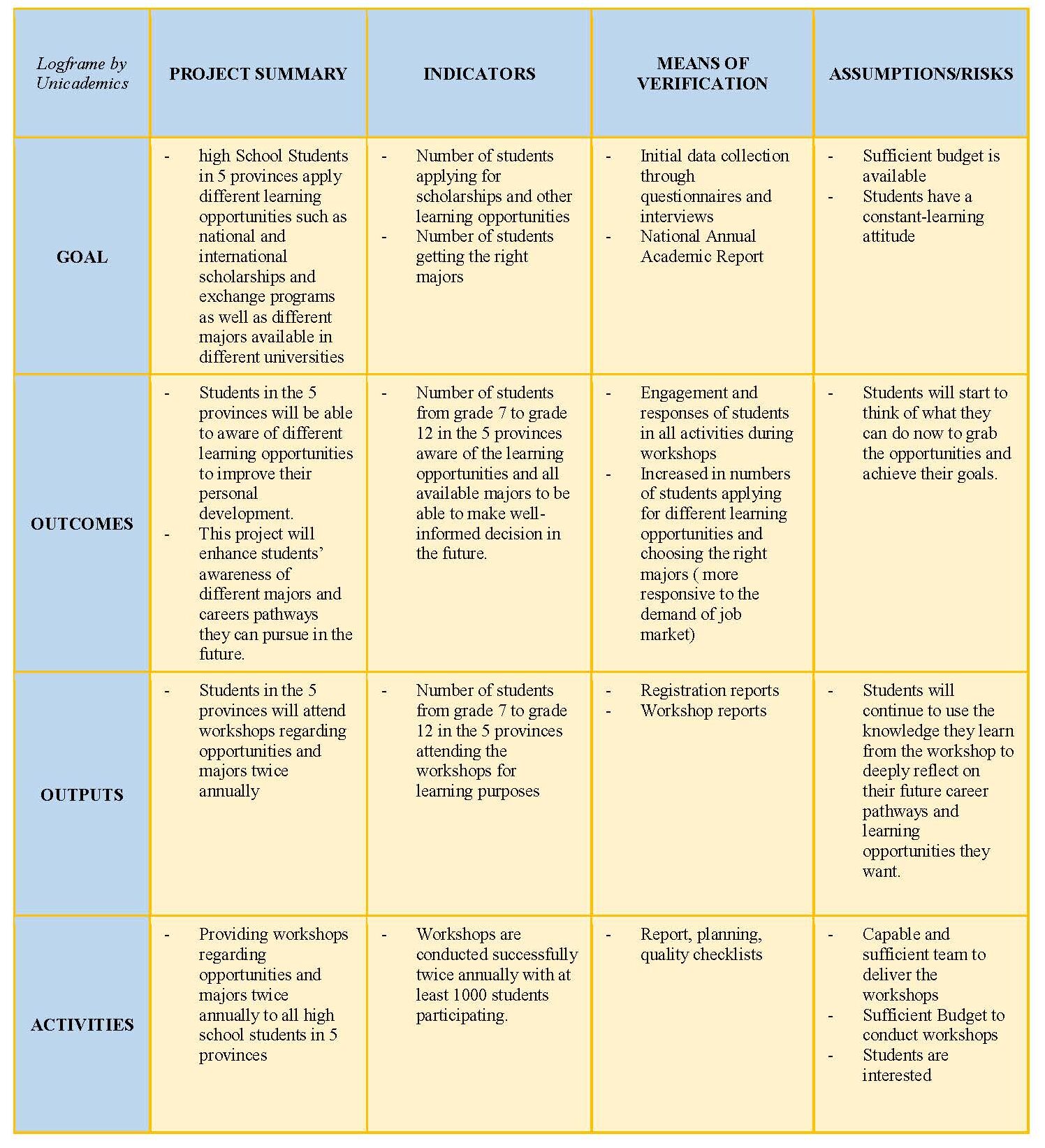
This is a table of logical framework. As you can see, on the left-hand side, it has goal, outcome, output and activities. Then, each component has its own project summary, indicators, means of verification and risks/assumptions.
Basically, your logframe should mention the following information.
- What the project will achieve
- What activities will be carried out
- What inputs are required (human resources, technical resources, logistics, infrastructure, etc.)
- What risks could impact your project
- What assumptions are made to support the project
- How progress and success will be measured and verified
Preparation for Logical Framework
First of all, you need to discuss and find a common ground within your team and funders. Discussion should be what your project is about. You can consider the following guiding questions.
- Who are the beneficiary?
- What is the problem?
- Why is the issue important?
- Who are stakeholders?
- What is the cause of the issue?
Next, write down all ideas/ opinions mentioned in the meeting on a board, sticky notes, laptops or a piece of paper. During discussion, you can start develop your problem tree. Once you have a problem tree and then find solutions to the problems, you can start develop an objective tree.
You can consider the following guiding quesitons.
- What is your solution?
- What is the main goal/objective of the project?
- What outcome do you want to see?
- What activities do you want to do?
- How are you going to measure your success?
- How much budget do you need?
At this point, you can start thinking of the goals/ objectives/outcome/output you want to achieve in your project. Then, you can transform these ideas into your logframe.
How to Write a Logical Framework?
You should start to identify your main goal or objective of your project. Goal is the long-term impact/result you want to achieve. After you have identify your goal, you can then start to identify outcomes you want, which can be considered as the medium impact. You can have one or two outcomes. Outputs are the short-term impact/result you want. you can list between 1 to 5 outputs. Activities are what you undertake to achieve your output. The activities can be as many as you wish as long as you have sufficient budget and capactities to run them. However, your activities must be
Project Summary is what goal, outcome, output and activities are about. Indicators are what you use to measure your achievement. It can be data, reports and so on. Mean of Verification is how you are going to collection information to determine whether your acheivement has been reach. Last but not least, Risks/ Assumptions are external factor you hope to be is true but totally uncontrollabl. Therefore, if your assumptions are not true, your project will be affected too. You should start from the top left column which is your goal and then work your way down to activities. Then, try to complete all blank boxes.
Example of Logframe:
Logic Model
Everything in logical framework is interconnected, and it works with If……and…….., then…… Logic Model. As you can see from the logframe below, you can start to connect your logic from the activities and work your way up to the top of the matrix.

Basically, if your activities are successfully conducted and your assumption is true, then you will achieve your outputs. If your outputs are achieved and your assumption related to your output is true, then you will achieve your expected outcomes. If your expected outcomes are met and your assumption is true, then you will achieve your goal.


